


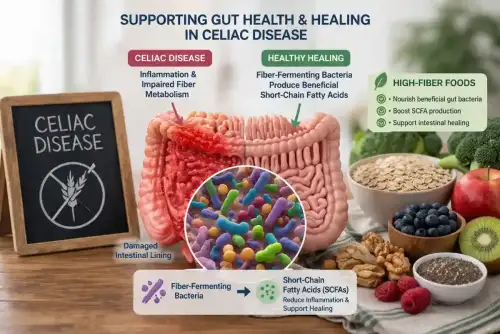
Celiac.com 05/12/2026 - Celiac disease is commonly understood as an immune reaction to gluten that damages the small intestine. While avoiding gluten remains the primary treatment, this study explores an important question: are there other factors inside the gut that influence how the disease develops and heals?
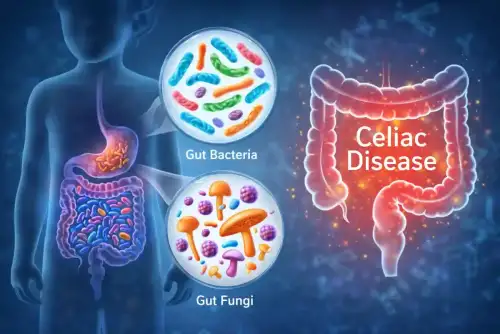
Researchers focused on the role of gut bacteria and how they process dietary fiber. Their findings suggest that changes in these bacteria may affect inflammation, healing, and overall intestinal health in people with celiac disease.
The Role of Gut Bacteria in Digestive Health
Celiac.com Sponsor (A12):
The human gut contains trillions of bacteria that help digest food, produce nutrients, and regulate the immune system. One of their key roles is breaking down dietary fiber, which humans cannot digest on their own.
When gut bacteria process fiber, they produce beneficial substances that support intestinal health, reduce inflammation, and help maintain a balanced digestive environment. These substances are especially important in protecting the lining of the intestine.
This study investigated whether this fiber-processing function is altered in people with celiac disease.
What the Study Looked At
The researchers compared three groups of people:
- Individuals newly diagnosed with celiac disease
- People with celiac disease who had been following a gluten-free diet for at least two years
- Healthy individuals without celiac disease
They analyzed samples from the small intestine and stool to examine the types of bacteria present and how effectively those bacteria could process fiber.
They also used laboratory mouse models to better understand how dietary fiber and specific bacteria influence intestinal healing.
Key Finding: Reduced Fiber Processing in Celiac Disease
One of the most important discoveries was that people with celiac disease had a reduced ability to process fiber in the small intestine. This was true both for those newly diagnosed and for those already following a gluten-free diet.
The study found that certain beneficial bacteria responsible for breaking down fiber were less abundant in individuals with celiac disease. This reduction was not simply due to diet differences, suggesting a deeper imbalance in the gut.
Visual data presented in the early figures of the study showed clear differences in bacterial diversity and composition between healthy individuals and those with celiac disease.
Lower Production of Helpful Gut Compounds
Because fiber was not being processed as efficiently, people with celiac disease produced lower levels of beneficial compounds created during fiber digestion.
These compounds play a key role in:
- Reducing inflammation
- Supporting the intestinal lining
- Helping regulate immune responses
According to the data shown in mid-study charts, individuals with active celiac disease had the lowest levels of these protective compounds, while those on a gluten-free diet showed partial improvement.
Diet Alone Does Not Fully Explain the Problem
Interestingly, the study found that fiber intake was generally low across all groups, including healthy individuals. However, this alone did not explain the differences in gut function.
Even when people consumed similar amounts of fiber, those with celiac disease still showed reduced ability to process it. This suggests that the issue is not just what people eat, but how their gut bacteria function.
The analysis of dietary patterns confirmed that while gluten-free diets change food choices, they do not fully account for the observed microbial differences.
Testing Fiber and Healing in a Controlled Setting
To better understand cause and effect, researchers used specially designed mouse models that mimic aspects of celiac disease. These mice were exposed to gluten and then switched to a gluten-free diet.
Some of the mice were given additional dietary fiber, while others were not.
The results were striking:
- Mice that received certain types of fiber healed faster
- They showed improved intestinal structure and reduced inflammation
- Mice without added fiber recovered more slowly
Images of intestinal tissue in the study clearly show healthier structures in mice that received fiber compared to those that did not.
Why Certain Fibers Worked Better
Not all types of fiber had the same effect. One specific type of fiber stood out for its ability to improve healing.
This fiber increased the production of beneficial compounds in the small intestine and supported a healthier gut environment. It also worked without dramatically changing the overall composition of gut bacteria, suggesting it improved function rather than simply altering which bacteria were present.
The Importance of Specific Bacteria
The study highlighted a group of bacteria that are particularly good at breaking down fiber. These bacteria were found at lower levels in people with celiac disease.
When researchers introduced these bacteria into controlled laboratory conditions, they observed increased production of beneficial compounds—especially when fiber was available.
This suggests that both the presence of the right bacteria and the availability of the right type of fiber are necessary for optimal gut health.
A Cycle of Imbalance in the Gut
The findings point to a cycle that may occur in celiac disease:
- Loss of fiber-processing bacteria reduces beneficial compound production
- Lower levels of these compounds lead to more inflammation
- Inflammation further disrupts the gut environment
This cycle may help explain why some people continue to experience symptoms or slow healing even after removing gluten from their diet.
Limitations and Areas for Future Research
The researchers noted that their study had some limitations, including a relatively small number of human participants and challenges in directly measuring certain compounds in the small intestine.
However, the combination of human data and controlled laboratory experiments provides strong support for their conclusions.
Future studies may explore whether targeted dietary changes or therapies that restore beneficial bacteria could improve outcomes for people with celiac disease.
Conclusion: Why This Study Matters for People with Celiac Disease
This study offers an important new perspective on celiac disease by showing that gut bacteria and fiber metabolism play a significant role alongside gluten.
It suggests that even after adopting a gluten-free diet, some underlying issues in the gut may persist, affecting healing and overall health.
For people with celiac disease, these findings highlight the potential value of focusing not only on avoiding gluten but also on supporting gut health through diet and possibly future treatments.
In the future, personalized approaches that combine a gluten-free diet with strategies to improve gut bacteria and fiber metabolism may offer better outcomes and improved quality of life.
Read more at: nature.com









Recommended Comments
Create an account or sign in to comment
You need to be a member in order to leave a comment
Create an account
Sign up for a new account in our community. It's easy!
Register a new accountSign in
Already have an account? Sign in here.
Sign In Now