



Celiac.com 05/25/2026 - A major new study suggests that human evolution did not slow to a crawl after farming, cities, and technology began to reshape daily life. Instead, the researchers found evidence that natural selection continued to influence human genes across western Eurasia during the past 10,000 years. By studying genetic material from more than 15,000 ancient people, the team concluded that many gene changes became more common because they likely helped people survive or have more children in the environments of their time.
This finding challenges the long-held idea that recent human history has been driven mostly by culture rather than biology. While cultural change clearly transformed diet, disease exposure, settlement patterns, and social life, the study argues that those same forces may also have pushed human biology to keep adapting. In other words, human culture did not replace evolution. It may have created new conditions that kept evolution moving.
What the Researchers Found
Celiac.com Sponsor (A12):
The investigators developed a new way to track how often certain genetic changes appeared in ancient populations over long stretches of time. Their goal was to identify steady increases or decreases that were more likely to reflect natural selection rather than simple population mixing or migration. Using this method, they found hundreds of genetic variants that appear to have been strongly shaped by natural selection over the past ten millennia.
Earlier studies had found only a small number of clear examples of recent human genetic adaptation. This much larger dataset revealed a far broader pattern. Instead of seeing only a handful of changes, the researchers identified hundreds of gene variants that seem to have risen or fallen in frequency in a sustained way. That suggests natural selection was more widespread and more active in recent human history than many experts once believed.
The study also looked beyond single gene changes and examined combinations of many genes linked to complex human traits. These included traits related to body fat, disease risk, and certain measures connected with learning and thinking. The researchers reported that these gene combinations also shifted over time, which may point to natural selection acting on broad biological patterns rather than just isolated gene changes.
Why These Genetic Changes May Have Happened
The study does not claim to know the exact reason behind every shift. However, the past 10,000 years brought enormous lifestyle changes that could have created strong pressures on human health and survival. Farming changed what people ate. Permanent settlements increased population density. Close contact with animals and larger communities likely changed exposure to infections. Seasonal food shortages, crowding, sanitation, and new social structures may all have affected which traits were helpful.
Some changes may have helped the immune system respond to new disease threats. Others may have influenced how the body used energy, stored fat, or processed food. In a hunting and gathering world, storing energy efficiently may have helped people survive scarcity. In farming societies with more regular access to grain-based foods, that same tendency may not have been as beneficial. The study suggests that some gene variants tied to body fat and blood sugar regulation became less common over time, possibly reflecting these changing conditions.
The researchers also found examples where a gene variant appeared to rise for thousands of years and then later declined. That pattern suggests that what helped people in one era could become harmful in another. Evolution does not move toward perfection. It responds to changing circumstances, and what is useful in one setting may become a disadvantage later on.
The Celiac Disease Connection
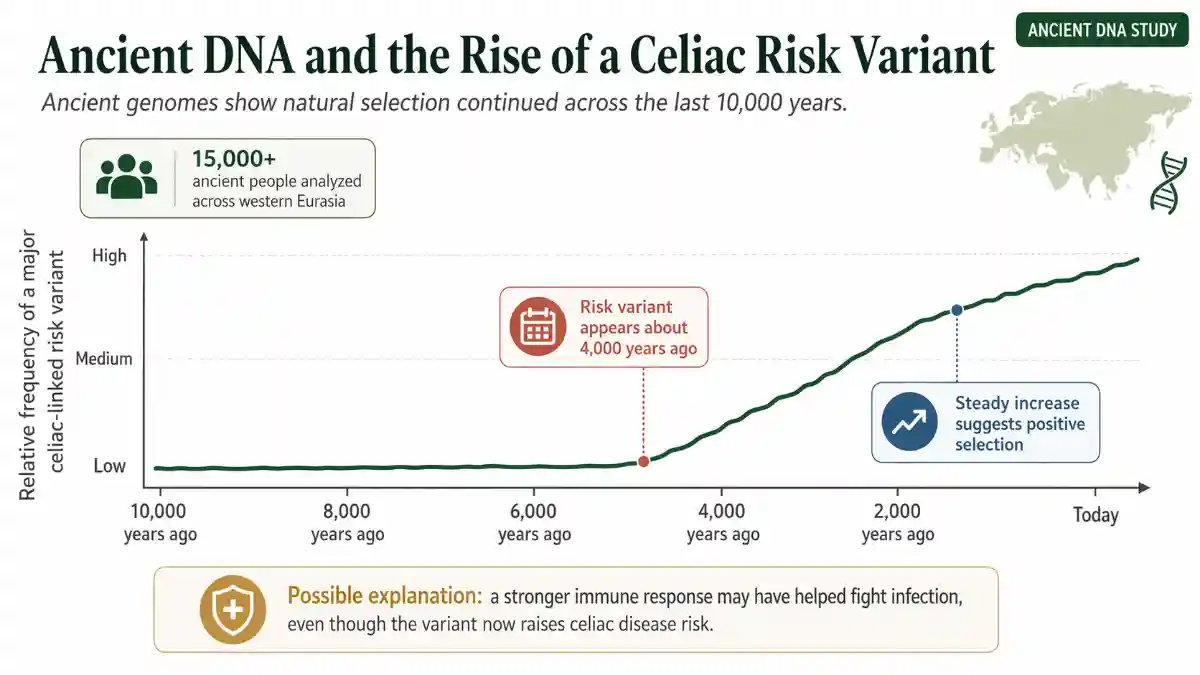
One of the most striking findings for readers interested in celiac disease is that a major genetic risk factor linked to the condition appears to have become more common only within the past several thousand years. According to the study summary, this change may have arisen about 4,000 years ago and then steadily increased in frequency. That is surprisingly recent in human history.
This does not mean celiac disease itself suddenly appeared at that moment, nor does it mean everyone with the gene developed the condition. It does suggest, however, that a gene variant now tied to celiac disease may once have provided some other advantage that helped it spread. That advantage may have involved the immune system. Scientists quoted in the summary suggested that the gene might have helped people respond more strongly to certain infections, perhaps in the gut. If so, a gene that now increases the risk of an autoimmune condition may have once improved survival under very different historical conditions.
This idea fits a larger pattern seen in human biology. Some gene variants linked to disease today may have been helpful in the past. Evolution does not select for what is healthiest in a modern medical sense. It favors what helps people survive and reproduce in the conditions around them. A stronger immune response may have protected against infection long ago, even if that same biological tendency now raises the risk of immune-related illness.
Questions and Cautions
Even though the study is impressive in size and ambition, not all scientists are equally convinced by every part of it. Some experts praised the enormous amount of ancient genetic data and agreed that at least many of the reported signals are likely real. Others urged caution, especially when interpreting more complex traits influenced by many genes at once.
That caution is important. A genetic change becoming more common over time does not automatically reveal exactly what it did or why it spread. Population movements, intermarriage, and regional differences can complicate the picture. Also, traits measured in modern societies do not always translate neatly into the ancient world. For example, a genetic pattern linked today to years spent in school cannot be interpreted literally in prehistoric populations. It may reflect other underlying biological or behavioral tendencies rather than formal education itself.
So while the overall message of the study is powerful, many of the details will need further testing. Future research in other world regions, and more work on the biology behind specific gene variants, will help clarify which findings prove strongest over time.
Why This Study Matters for People with Celiac Disease
This study could be meaningful to people with celiac disease because it supports the idea that the genes connected to the condition are part of a much deeper story about human survival, diet, and immune system change. Rather than being a simple modern flaw, one important celiac-related genetic risk factor may have spread because it once offered a real benefit in the world our ancestors lived in.
That matters because it helps explain why celiac-related genes can be so common even though the disease can be harmful. It also reminds us that the human body is shaped by trade-offs. A genetic trait that may have helped defend against infection in the past could increase the risk of immune overreaction in the present. For people with celiac disease, this kind of research may eventually improve understanding of why the condition is so widespread, why immune responses to gluten can be so strong, and how ancient evolutionary pressures still affect health today.
In that sense, the study does more than rewrite part of human history. It may also help explain why conditions like celiac disease remain so important in the modern world.
Read more at: nature.com and nytimes.com











Recommended Comments
There are no comments to display.
Create an account or sign in to comment
You need to be a member in order to leave a comment
Create an account
Sign up for a new account in our community. It's easy!
Register a new accountSign in
Already have an account? Sign in here.
Sign In Now