Jump to content
  • You are not alone. Join Celiac.com for trusted gluten-free answers and forum support.


  • Celiac.com Sponsor (A1):
    Celiac.com Sponsor (A1-M):
  • Scott Adams
    Scott Adams

    New Study Reveals Hidden Gut Damage in Celiac Disease—Even Without Gluten (+Video)

    Reviewed and edited by a celiac disease expert.

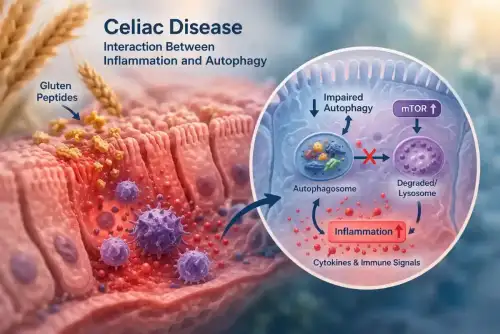
    A new study reveals how inflammation and impaired cell repair continue in celiac disease—even on a gluten-free diet—offering new insight into persistent symptoms and future treatments.

    New Study Reveals Hidden Gut Damage in Celiac Disease—Even Without Gluten (+Video) - Image: Celiac.com ++ Watch the Video ++
    Caption: Image: Celiac.com ++ Watch the Video ++

    Celiac.com 05/11/2026 - Celiac disease is widely known as a condition triggered by gluten that damages the small intestine. However, the underlying processes that drive this damage are complex and still being explored. This study takes a closer look at how inflammation inside the gut interacts with a natural cellular process called autophagy, which helps cells clean up and recycle damaged components.

    By studying both patient tissue samples and lab-grown intestinal models, researchers aimed to understand how these two processes influence each other and contribute to the disease.

    What Is Autophagy and Why Does It Matter?

    Celiac.com Sponsor (A12):
    Autophagy is a basic function inside cells that acts like a recycling system. It removes damaged parts and helps maintain balance within the cell. When this process works properly, it supports healthy cell function and helps control inflammation.

    In celiac disease, this study found that autophagy does not work as efficiently as it should. When this cleanup system slows down, harmful substances and signals can build up inside cells, potentially triggering or worsening inflammation.

    How the Study Was Conducted

    Researchers examined intestinal tissue from children with active celiac disease, those following a gluten-free diet, and individuals without the condition. They also created intestinal organoids, which are miniature lab-grown versions of the gut that mimic how intestinal cells behave.

    These organoids allowed scientists to test how different conditions affect inflammation and cell function. They also used specific compounds to either block or stimulate the cell cleanup process to observe how these changes influenced inflammation.

    Key Finding: Reduced Cellular Cleanup in Celiac Disease

    The study found clear signs that the cell cleanup process was impaired in people with celiac disease. This was true not only in those actively consuming gluten but also in those already following a gluten-free diet.

    Markers associated with damaged or unprocessed cellular material were significantly higher in celiac samples. This suggests that the cells were struggling to properly remove waste and maintain balance.

    Visual evidence from tissue imaging, such as the staining patterns shown in the figures on early pages of the study, confirmed that these changes were present directly in the intestinal lining.

    Inflammation Remains Active Even Without Gluten

    One of the most important findings is that inflammation does not completely disappear when gluten is removed from the diet. While it may be reduced, signs of ongoing immune activity were still present in patients who were no longer consuming gluten.

    This suggests that celiac disease involves deeper, long-lasting changes in the gut that are not entirely reversed by diet alone.

    The Role of the mTOR Pathway

    The study also identified increased activity in a cellular pathway that controls growth and stress responses. This pathway becomes more active when cells are under pressure, such as during inflammation.

    When the cell cleanup system is impaired, this pathway becomes overactive, further promoting inflammation and disrupting normal cellular balance.

    Experimenting with Cell Function: Blocking and Restoring Balance

    To better understand cause and effect, researchers manipulated the system in lab-grown intestinal cells.

    • When they blocked the cleanup process, inflammation increased.
    • When they stimulated the cleanup process, inflammation decreased.

    This clearly demonstrated a direct relationship between these two processes. When cells cannot properly clean themselves, inflammation worsens. When cleanup improves, inflammation can be reduced.

    Inflammatory Signals Spread the Problem

    The study also showed that inflammatory substances released by affected cells can influence nearby healthy cells. When healthy intestinal cells were exposed to these signals, they began to show the same problems—reduced cleanup ability and increased inflammation.

    This finding suggests that inflammation in celiac disease may spread through the gut, amplifying the overall response.

    Data from the charts showing multiple inflammatory markers, such as those displayed in the mid-section figures of the study, illustrate how widespread these signals can be.

    A Network of Inflammation in the Gut

    The researchers identified a complex network of inflammatory molecules that interact with each other. These molecules are involved in immune signaling, cell communication, and tissue repair.

    Analysis of this network revealed strong connections between different inflammatory pathways. These interactions help explain why celiac disease can be persistent and difficult to fully control.

    Even in patients on a gluten-free diet, some of these inflammatory signals remained elevated, indicating a lingering imbalance in the gut environment.

    What This Means for Understanding Celiac Disease

    This study suggests that celiac disease is not just a reaction to gluten but also involves deeper changes in how intestinal cells function. Problems with cellular cleanup and ongoing inflammation appear to reinforce each other, creating a cycle that can persist over time.

    These findings may help explain why some patients continue to experience symptoms even after removing gluten from their diet.

    Potential Future Directions

    The results open the door to new ways of thinking about treatment. Instead of focusing only on removing gluten, future therapies might aim to:

    • Improve cellular cleanup processes
    • Reduce underlying inflammation
    • Interrupt the cycle between inflammation and cell dysfunction

    While more research is needed, this approach could lead to more comprehensive management of the disease.

    Conclusion: Why This Study Matters

    This research provides important insight into the biological processes behind celiac disease. It shows that inflammation and impaired cellular repair are closely linked and may continue even after dietary changes.

    For people with celiac disease, this helps explain why symptoms can persist and why healing may take time. It also highlights the importance of ongoing monitoring and the potential for new treatments that go beyond diet alone.

    Ultimately, this study moves us closer to understanding celiac disease as a complex condition involving both immune responses and cellular function, offering hope for better care and improved quality of life in the future.

    Read more at: nature.com

    Watch the video version of this article:

    Watch the super short video version of this article:


    User Feedback

    Recommended Comments

    Lotte18

    I think so many of us reading this article are saying, "I told you so!"  The question then becomes, what was used to "stimulate the clean up process?"  Is there something we should add to our diets that helps with that?  

    Link to comment
    Share on other sites
    Jewelzie

    So does this mean fasting induced autophagy is still a good idea for those suffering from Celiac disease, or not?

    Link to comment
    Share on other sites
    trents

    Agree with @Lotte18! It answers a lot of questions. This is a landmark study! Save this link if you are a regular poster in these forums who seeks to help others, particularly those who are diligent in their gluten free eating effort but still not recovering. And yes, we need to know what was used to stimulate the "clean up process". Whatever that was, it would seem to have great promise as a therapy.

    Link to comment
    Share on other sites
    Scott Adams

    Inulin fiber may help:


    Link to comment
    Share on other sites


    Create an account or sign in to comment

    You need to be a member in order to leave a comment

    Create an account

    Sign up for a new account in our community. It's easy!

    Register a new account

    Sign in

    Already have an account? Sign in here.

    Sign In Now

  • Get Celiac.com Updates:
    Support Celiac.com:
    Donate
  • About Me

    Scott Adams
    scott_adams_dotcomer.webp

    Scott Adams was diagnosed with celiac disease in 1994. Faced with a critical lack of resources, he dedicated himself to becoming an expert on the condition to achieve his own recovery.

    In 1995, he founded Celiac.com with a clear mission: to ensure no one would have to navigate celiac disease alone. The site has since grown into one of the oldest and most trusted patient-focused resources for celiac disease and the gluten-free lifestyle.

    His work to advance awareness and support includes:

    Today, Celiac.com remains his primary focus. To ensure unbiased information, the site does not sell products and is 100% advertiser supported.


  • Celiac.com Sponsor (A17):
    Celiac.com Sponsor (A17):


    Celiac.com Sponsors (A17-M):


  • Related Articles

    Jefferson Adams
    The In Vitro Effects of Enzymatic Digested Gliadin on the Functionality of the Autophagy Process
    Celiac.com 06/26/2018 - Gliadin is an alcohol-soluble wheat protein that is toxic for people with celiac disease. Gliadin toxicity is not lowered by digestion with gastro-pancreatic enzymes. It’s been documented that an innate immunity to gliadin plays a key role in the development of celiac disease. This is mainly due to an immune response that induces epithelial stress and reprograms intraepithelial lymphocytes into natural killer (NK)-like cells, leading to enterocyte apoptosis and an increase in epithelium permeability.
    A team of researchers recently set out to elaborate on the role played by innate immunity to gliadin in the development of celiac disease by assessing the in vitro effects of enzymatic digested gliadin on the functionality of the process of autophagy, or natural cell...


    Jefferson Adams
    Chronic Celiac Inflammation Permanently Changes Tissue-Resident Immunity
    Celiac.com 03/04/2019 - Tissue-resident lymphocytes play a key role in immune surveillance, but there’s not much data on how these cells respond to chronic inflammation. A team of researchers recently set out to assess how well tissue-resident lymphocytes respond to chronic inflammation. The research team included Toufic Mayassi; Kristin Ladell; Herman Gudjonson; Jamie Rossjohn; David A. Price; and Bana Jabri.
    In celiac disease, the team found that gluten-induced inflammation substantially reduced levels of naturally occurring Vγ4 +/Vδ1 + intraepithelial lymphocytes (IELs) with innate cytolytic properties and specificity for the butyrophilin-like (BTNL) molecules BTNL3/BTNL8. 
    Creation of a new niche with reduced expression of BTNL8 and loss of Vγ4 +/Vδ1 + IELs occurred togethe...


    Scott Adams
    Gluten Exposure Common, Silent and Ongoing in Most Celiac Patients
    Celiac.com 11/09/2020 - Most people with celiac disease attempt to follow a gluten-free diet. There have been a few studies that indicate that people with celiac disease are regularly exposed to gluten. However, there isn't much good data on the subject. Limited data on real world gluten exposure presents a major roadblock to better knowledge and improved treatment for celiac disease. 
    In an effort to change that, a team of researchers recently set out to estimate gluten exposure on a gluten-free diet using immunoassays for gluten immunogenic peptides (GIP) and to examine relationships among GIP detection, symptoms and suspected gluten exposures.
    The research team included Jocelyn A. Silvester; Isabel Comino; Lisa N. Rigaux; Veronica Segura; Kathy H. Green; Angel Cebolla; D...


    Scott Adams
    Researchers Harness Erythrocyte Clearance Pathways to Disarm Overactive T Cells
    Celiac.com 03/22/2021 - Dysfunctional T cells play a major role in the immune evasion in cancer and chronic viral infection. Researchers have been looking for ways to trigger dysfunction in autoreactive T cells to create self-tolerance. 
    Although most current treatments for autoimmunity involve broad immunosuppression, recent efforts have aimed to suppress T cells in an antigen-specific manner to minimize risk of infection. 
    In a prior experiment, researchers used phage display to isolate a human antibody fragment (Fab) that selectively binds erythrocytes, allowing efficient antigen targeting to splenic antigen-presenting cells that rapidly clear apoptotic erythrocytes. Fab-tethered antigen induced antigen-specific T cell dysfunction in mice that was sustained in response t...


  • Recent Activity

    1. - Aretaeus Cappadocia replied to cristiana's topic in Related Issues & Disorders
      1

      Low iron/high normal haemoglobin

    2. - cristiana posted a topic in Related Issues & Disorders
      1

      Low iron/high normal haemoglobin

    3. - Scott Adams replied to JForman's topic in Coping with Celiac Disease
      11

      7yo struggling!

    4. - Scott Adams commented on glutenfreelexi's blog entry in GlutenFreeLexi's Blog
      7

      Need Some Feedback Please

  • Celiac.com Sponsor (A19):
  • Member Statistics

    • Total Members
      134,170
    • Most Online (within 30 mins)
      10,442

    yvonne jacobs
    Newest Member
    yvonne jacobs
    Joined
  • Celiac.com Sponsor (A20):
  • Celiac.com Sponsor (A22):
  • Forum Statistics

    • Total Topics
      121.7k
    • Total Posts
      1m
  • Celiac.com Sponsor (A21):
  • Popular Now

    • coeliacmamma
      11
    • BelleDeJour
  • Popular Articles

    • Scott Adams
    • Scott Adams
    • Scott Adams
    • Scott Adams
    • Scott Adams
  • Upcoming Events

×
×
  • Create New...