
Jump to content
  • Welcome to Celiac.com!

    You have found your celiac tribe! Join us and ask questions in our forum, share your story, and connect with others.


  • Celiac.com Sponsor (A1):
    Celiac.com Sponsor (A1-M):
  • Get Celiac.com Updates:
    Support Our Content
    eNewsletter
    Donate
  • Scott Adams
    Scott Adams

    Study Reveals Subtle Clues That Can Signal Celiac Disease Long Before It's Diagnosed (+Video)

    Reviewed and edited by a celiac disease expert.

    A large study finds that subtle lab abnormalities and mild digestive symptoms can appear years before celiac disease is diagnosed, highlighting the importance of earlier screening and awareness.

    Celiac.com 03/02/2026 - This research looked at subtle signs that might appear long before adults are formally diagnosed with celiac disease. Celiac disease is an autoimmune condition triggered by gluten that can harm the small intestine and cause a variety of health problems. Adults often receive diagnoses later than children because their symptoms can be mild or non-specific. The goal of this study was to find patterns in laboratory test results and clinical records that could help doctors recognize the disease sooner in people aged eighteen to forty years.

    How the Study Was Done

    Researchers reviewed the medical records of more than four hundred thirty thousand adults who were members of a large health care system. They identified people who were diagnosed with celiac disease and compared them to those who were not. For those who developed celiac disease, the team examined laboratory test results and clinical data from up to seven years before diagnosis. The tests included measurements of blood hemoglobin, mean corpuscular volume, liver enzymes, and body mass index. They also looked at symptoms and other clinical diagnoses that appeared before celiac disease was identified.

    Key Laboratory Findings

    Celiac.com Sponsor (A12):
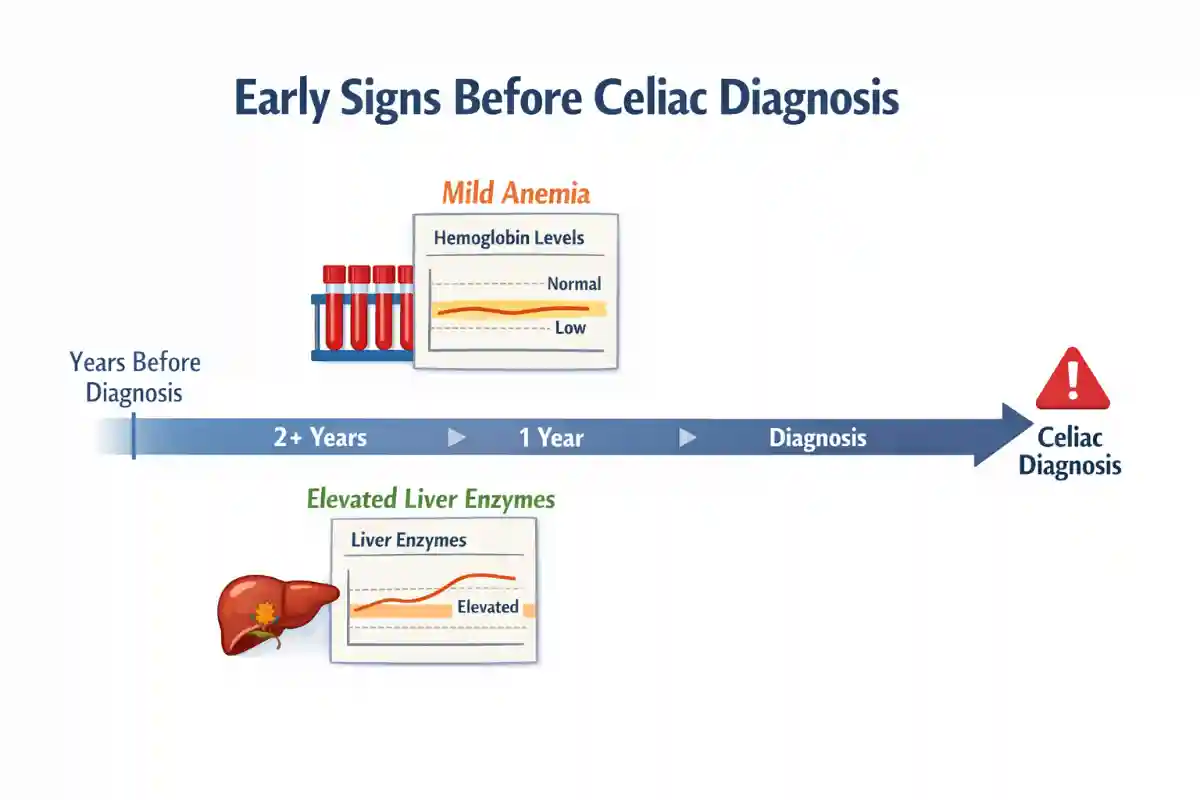
    One of the most important findings was that many adults who later received a diagnosis of celiac disease showed signs of mild anemia before they were diagnosed. Anemia occurs when there are lower than normal levels of hemoglobin, the protein in red blood cells that carries oxygen. This was particularly noticeable in women, but also occurred in men. Slightly elevated liver enzyme levels were another subtle sign. Liver enzymes are blood proteins that can indicate liver stress or mild inflammation even when the levels are still technically within normal limits. Finally, people who went on to be diagnosed with celiac disease tended to have body mass index values at the lower end of the normal range, suggesting a pattern of subtle undernutrition or poor absorption long before diagnosis.
    early_celiac_disease_signs.webp

    Patterns in Clinical Symptoms

    In addition to laboratory changes, the study found that repeated gastrointestinal complaints such as ongoing abdominal pain, diarrhea, or other digestive discomfort often preceded a celiac disease diagnosis. These symptoms are not always dramatic or obvious, but their persistence over time was linked to a higher likelihood of later developing celiac disease. Interestingly, many other symptoms that are often mentioned in connection with celiac disease, such as fatigue, headache, and psychiatric or neurological symptoms, were not found to strongly predict a future diagnosis in this group of young adults.

    How Far in Advance These Signs Appeared

    The subtle changes described above were not random or short-lived. They often appeared up to seven years before a formal diagnosis of celiac disease. For example, small drops in hemoglobin and mean corpuscular volume could be traced back several years before the disease was identified. Elevated liver enzymes also tended to show up earlier than the point of diagnosis, growing more noticeable as time passed. Although body mass index did not deviate dramatically from normal values, the trend toward lower normal body mass index was consistent across many future celiac disease patients.

    Statistical Evidence and Risk Patterns

    In statistical models that accounted for many variables, the strongest signals predicting a later diagnosis of celiac disease were low blood hemoglobin, elevated liver enzyme levels, lower body mass index within the normal range, and repeated gastrointestinal symptoms. Some chromosomal abnormalities, such as Down syndrome and Turner syndrome, were associated with especially high risk, although these cases were rare. Other health conditions that people sometimes associate with celiac disease, such as obesity, infertility, or fatigue, did not show a clear link with subsequent diagnosis in this study.

    What This Means in Practice

    This study suggests that celiac disease may not appear suddenly with dramatic symptoms in many adults. Instead, it may begin with small, easily overlooked changes in basic blood tests and ongoing mild symptoms. These can occur long before health care providers think to test for celiac disease. The fact that mild anemia, slight liver enzyme elevations, and lower body mass were detectable up to years before diagnosis suggests that paying closer attention to these patterns could lead to earlier testing. Early diagnosis in celiac disease matters because untreated disease can lead to complications such as nutritional deficiencies, weakened bones, and other long-term health issues.

    Limitations of the Study

    Like all research, this study has limitations. It looked back at medical records rather than following people forward in time, so there could be incomplete or inconsistent data. Some symptoms might not have been recorded at all if patients did not report them or if doctors did not code them in the record. The study also defined celiac disease cases based on diagnostic codes combined with positive serology tests, which might miss some people who were diagnosed in other ways. Finally, because the study focused on a specific health care population, its findings may not apply equally to all groups of people.

    Why This Study Matters for People With Celiac Disease

    For individuals with celiac disease and their families, this research highlights that the condition can begin subtly and unfold over many years. It shows that mild abnormalities in common lab tests and lingering digestive symptoms may be early warning signs of celiac disease long before a formal diagnosis is made. The knowledge that these markers can be detected years in advance could encourage both patients and doctors to consider celiac testing earlier rather than later. Earlier diagnosis and treatment — primarily through a strict gluten-free diet — can prevent the long-term effects of untreated celiac disease and improve quality of life. Understanding these early signals gives hope that more people may be diagnosed more quickly and with fewer complications.

    Read more at: link.springer.com

    Watch the video version of this article:

    Watch the super short video version of this article:


    User Feedback

    Recommended Comments

    There are no comments to display.


    Create an account or sign in to comment

    You need to be a member in order to leave a comment

    Create an account

    Sign up for a new account in our community. It's easy!

    Register a new account

    Sign in

    Already have an account? Sign in here.

    Sign In Now

  • Get Celiac.com Updates:
    Support Celiac.com:
    Join eNewsletter
    Donate
  • About Me

    Scott Adams
    scott_adams_dotcomer.webp

    Scott Adams was diagnosed with celiac disease in 1994. Faced with a critical lack of resources, he dedicated himself to becoming an expert on the condition to achieve his own recovery.

    In 1995, he founded Celiac.com with a clear mission: to ensure no one would have to navigate celiac disease alone. The site has since grown into one of the oldest and most trusted patient-focused resources for celiac disease and the gluten-free lifestyle.

    His work to advance awareness and support includes:

    Today, Celiac.com remains his primary focus. To ensure unbiased information, the site does not sell products and is 100% advertiser supported.


  • Celiac.com Sponsor (A17):
    Celiac.com Sponsor (A17):


    Celiac.com Sponsors (A17-M):


  • Related Articles

    Dr. Rodney Ford M.D.
    How Early Can You Diagnose Celiac Disease?
    Celiac.com 10/12/2016 - How early can you diagnose celiac disease? This is a most challenging question for everyone: children, parents, pediatricians, gastroenterologists and many other health professionals. This is because, like so many other diseases, celiac disease is a progressive condition that slowly creeps up on you. In addition, there is disagreement about what constitutes a definitive diagnosis of celiac disease. What if the small bowel biopsy result is at odds to the blood test results?
    It is my opinion that the fundamental diagnostic requirements for celiac disease remain unresolved. This makes early diagnosis problematic!
    Do you keep waiting (whilst suffering from symptoms) for classic gut damage to be visible in a bowel biopsy before adopting a gluten-free diet? Or do...


    Scott Adams
    Mass Screening is the Only Way to Find Celiac Disease in All Children
    Celiac.com 01/11/2021 - A team of researchers recently reported celiac disease outcomes and other data for about ten thousand of the first children screened by  Autoimmunity Screening for Kids (ASK), a large scale pediatric screening study in Colorado for celiac disease and type 1 diabetes. 
    The research team included Marisa G Stahl, Cristy Geno Rasmussen, Fran Dong, Kathleen Waugh, Jill M Norris, Judith Baxter, Liping Yu, Andrea K Steck, Brigitte I Frohnert, Edwin Liu, Marian J Rewers, and the ASK Study Group.
    They are variously affiliated with the Department of Pediatrics, Digestive Health Institute, School of Medicine, University of Colorado Anschutz Medical Campus, Aurora, Colorado, USA; the Barbara Davis Center for Diabetes, School of Medicine, University of Colorado A...


    Scott Adams
    Mass Screening Shows Celiac Disease Diagnoses in Children Have Doubled in 25 Years
    06/14/2021 - Professor Elena Lionetti and a team of research colleagues at the Department of Paediatrics at the Marche Polytechnic University, Ancona, Italy recently reported that mass screening of school age children has led to significantly higher numbers of celiac disease cases being diagnosed, compared to a similar study by the same group 25 years ago.
    A new blood screening program of 7,760 children aged from five to 11 across eight provinces of Italy showed overall celiac disease rates of 1.6%, much higher than the current 1% estimate.
    The finger-tip blood test screens for Human Leukocyte Antigens (HLA) gene mutations, which increase the chances for developing celiac disease. Children who tested positive for HLA mutations were then checked for antibodies to gluten.  <...


    Scott Adams
    Transformative Impact of Mass Screening and Treatment for Celiac Disease in Children
    Celiac.com 05/30/2024 - Celiac disease is a chronic autoimmune disorder triggered by gluten ingestion in genetically predisposed individuals. Despite its prevalence, celiac disease often goes undiagnosed or is diagnosed late due to varied symptoms or asymptomatic presentations. Mass screening for celiac disease remains a topic of debate within the medical community due to limited data supporting its benefits. The Autoimmunity Screening for Kids (ASK) study conducted in Colorado aimed to assess the impact of mass screening for pediatric celiac disease and type 1 diabetes.
    Study Overview
    The ASK study prospectively followed children aged 1-17 years who tested positive for tissue transglutaminase IgA autoantibodies (tTGA) through mass screening. Those subsequently diagnosed with...


  • Recent Activity

    1. - trents replied to HectorConvector's topic in Related Issues & Disorders
      326

      Terrible Neurological Symptoms

    2. - knitty kitty replied to HectorConvector's topic in Related Issues & Disorders
      326

      Terrible Neurological Symptoms

    3. - Scott Adams replied to Florence Lillian's topic in Post Diagnosis, Recovery & Treatment of Celiac Disease
      3

      Gluten-Mimicking Proteins that can affect some Celiac individuals.

    4. - Scott Adams replied to HectorConvector's topic in Related Issues & Disorders
      326

      Terrible Neurological Symptoms

    5. - Scott Adams replied to elisejunker44's topic in Gluten-Free Foods, Products, Shopping & Medications
      3

      Schar's products contain wheat!

  • Celiac.com Sponsor (A19):
  • Member Statistics

    • Total Members
      133,620
    • Most Online (within 30 mins)
      7,748

    JaclynH
    Newest Member
    JaclynH
    Joined
  • Celiac.com Sponsor (A20):
  • Celiac.com Sponsor (A22):
  • Forum Statistics

    • Total Topics
      121.6k
    • Total Posts
      1m
  • Celiac.com Sponsor (A21):
  • Popular Now

    • Known1
    • HectorConvector
      326
  • Popular Articles

    • Scott Adams
    • Scott Adams
    • Scott Adams
    • Scott Adams
    • Scott Adams
  • Upcoming Events

×
×
  • Create New...

Important Information

NOTICE: This site places This site places cookies on your device (Cookie settings). on your device. Continued use is acceptance of our Terms of Use, and Privacy Policy.