


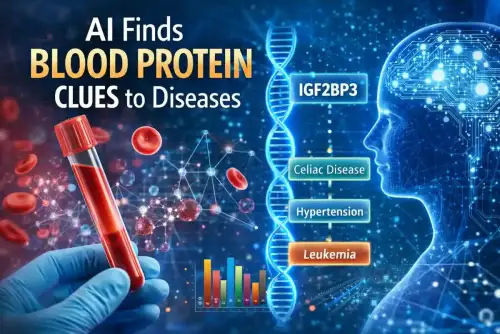
Celiac.com 04/04/2026 - Modern medicine is increasingly focused on identifying biological signals in blood that can help detect disease, predict risk, and guide treatment. Blood contains thousands of circulating proteins that reflect what is happening throughout the body. These proteins can signal inflammation, tissue damage, immune activity, or metabolic stress. Because blood is easy to collect, studying these proteins offers enormous potential for understanding health and disease.
Most previous research has relied on methods that look for differences between people who already have a known diagnosis and those who do not. While useful, this approach depends on predefined categories and may miss subtle patterns. In this study, researchers used a different strategy. Instead of telling the computer which disease to look for, they allowed advanced computational methods to sort people into groups based purely on patterns in their blood protein levels. This method is known as unsupervised learning.
The Data: Thousands of Proteins, Tens of Thousands of People
Celiac.com Sponsor (A12):
The researchers analyzed blood samples from more than fifty thousand participants in a large United Kingdom health database. Nearly three thousand different plasma proteins were measured for each person. This type of dataset is extremely complex. Every additional protein adds another dimension to the analysis, making it difficult to detect meaningful patterns.
The study developed a new analytical framework designed to handle this complexity. The goal was to identify clusters of individuals who shared similar protein patterns and then determine whether those clusters were linked to specific diseases.
Two Different Analytical Approaches
To organize the data, the team created two separate clustering workflows. One method minimized the impact of missing values by carefully grouping proteins with similar patterns of incomplete data. The other method filled in missing values using established mathematical techniques and then applied a community detection algorithm to find groups within the data.
Together, these approaches produced fifty-five distinct clusters of participants. Some clusters were small and tightly defined, while others were larger and broader. Each cluster represented a group of individuals with similar blood protein patterns.
Do These Clusters Mean Anything?
Once the clusters were created, the researchers examined whether certain diseases were more common in specific groups. They looked at age, sex distribution, and medical diagnoses. Some clusters showed clear biological patterns.
For example, certain clusters contained individuals with a higher prevalence of severe medical conditions such as organ failure or cancer. Other clusters were associated with differences in high blood pressure or autoimmune disease.
The key finding was that these groupings were not random. They reflected meaningful biological variation in protein levels.
Focus on Three Diseases
The researchers examined three conditions more closely: celiac disease, high blood pressure, and leukemia. For each disease, they identified proteins that were consistently higher or lower in clusters enriched for that condition.
Celiac Disease
In clusters associated with celiac disease, several proteins stood out. One of the strongest signals involved a protein called IGF2BP3. This protein has previously been linked to maintaining the integrity of the intestinal barrier. Because celiac disease involves immune reactions to gluten that damage the small intestine, a protein related to intestinal barrier function is biologically plausible.
Other proteins, including NRXN3 and CACNB1, were also highlighted as potential contributors. When the researchers combined protein levels into a single summary measure, they found that increasing values along this artificial axis were associated with a higher prevalence of celiac disease. This relationship was consistent even when applied to the entire study population.
Interestingly, the study also showed that protein co-regulation patterns changed in celiac-related clusters. In other words, proteins that normally rise and fall together became more strongly linked, suggesting coordinated biological shifts in people with the disease.
High Blood Pressure
Clusters enriched for high blood pressure showed more modest changes, which is consistent with the understanding that high blood pressure is influenced by many different biological pathways.
Three proteins drew particular attention: UBE2L6, HNRNPUL1, and BECN1. These proteins have previously been connected to cardiovascular processes. When individual proteins were removed from the analysis one at a time, the predictive strength of the cluster changed, suggesting that some proteins play a more central role.
The researchers also used a dimensionality reduction technique to summarize protein patterns. Again, movement along this protein-based axis correlated with increasing prevalence of high blood pressure across the broader population.
Leukemia
The leukemia analysis revealed striking patterns. Some clusters showed dramatically higher odds of leukemia. In these clusters, certain proteins such as LRCH4, WDR46, SERPINB1, and NUB1 were misregulated. Several of these proteins have previously been linked to cancer biology.
Unlike high blood pressure, leukemia clusters showed large shifts in how proteins were correlated with one another. Some protein relationships weakened, while many strengthened. This suggests that blood cancers may create widespread disruption in coordinated protein regulation.
Why This Approach Matters
Traditional analyses look at one disease at a time. In contrast, this method allowed patterns to emerge naturally from the data. It confirmed known biomarkers and uncovered plausible new candidates.
Importantly, the framework was designed to reduce false discoveries by using strict statistical corrections. While this conservative approach may miss weaker signals, it strengthens confidence in the findings that remain.
Limitations
The study had some constraints. Certain diseases were rare in the dataset, limiting statistical power. In addition, medication records appeared incomplete, which may have affected interpretation of some clusters.
However, the database is expanding dramatically, with future releases expected to include more proteins and hundreds of thousands of participants. This growth could allow the same method to identify patterns in rarer conditions.
Why This Study Is Meaningful for People with Celiac Disease
For individuals with celiac disease, this research reinforces the idea that the condition leaves measurable fingerprints in the blood beyond traditional antibody testing. The identification of IGF2BP3 and other proteins related to intestinal barrier integrity suggests new pathways that may be involved in disease development or progression.
If validated in future research, these protein patterns could one day help identify people at risk earlier, monitor disease activity more precisely, or even guide new treatments aimed at protecting the intestinal barrier.
More broadly, the study demonstrates that complex diseases can be understood not only by looking for known markers, but by allowing patterns in the body’s biology to reveal themselves. For people living with celiac disease, this type of unbiased discovery approach may open the door to deeper insights into immune regulation, gut integrity, and long-term health outcomes.
In summary, this research shows that unsupervised computational analysis of large blood protein datasets can uncover both known and previously unrecognized disease-associated proteins. For celiac disease, the findings highlight biologically plausible protein candidates and altered regulatory patterns, offering promising directions for future investigation.
Read more at: nature.com










Recommended Comments
There are no comments to display.
Create an account or sign in to comment
You need to be a member in order to leave a comment
Create an account
Sign up for a new account in our community. It's easy!
Register a new accountSign in
Already have an account? Sign in here.
Sign In Now