


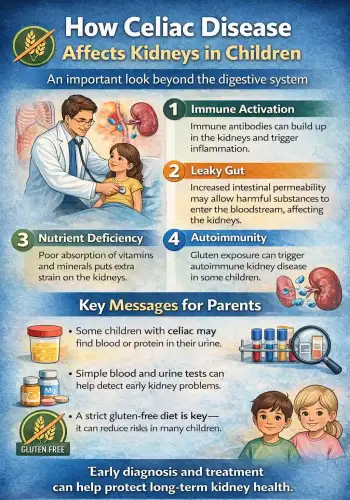
Celiac.com 02/16/2026 - This study is a literature review that looks at how celiac disease can affect the kidneys in children. Celiac disease is best known for damaging the small intestine after gluten exposure, but the authors emphasize that it can also involve other organs. They focus on kidney conditions that have been reported in pediatric patients, why these problems may happen, how they might show up clinically, and why early recognition and a strict gluten-free diet may help protect long-term kidney health.
Big Picture: Celiac Disease Is Not Only an Intestinal Condition
Celiac disease is an immune-driven condition in which gluten triggers inflammation and injury in the small intestine. Over time, this can lead to poor absorption of nutrients such as vitamins and minerals. The review explains that celiac disease is increasingly recognized as a systemic illness, meaning that immune activity and nutritional consequences can affect multiple body systems. The kidneys are one of the organ systems that may be involved, but kidney screening practices in children with celiac disease are not standardized and may vary widely between clinicians and regions.
Celiac.com Sponsor (A12):
The authors highlight that kidney involvement may be underrecognized. Some children may have mild kidney changes at first, while others may develop more serious problems that can progress if not identified early. Because children’s bodies are still developing, the authors argue that early detection and consistent follow-up are particularly important.
How Celiac Disease Could Affect the Kidneys
The review describes several pathways that may link celiac disease to kidney injury.
First, immune activation plays a central role. In celiac disease, the immune system produces antibodies and inflammatory signals after gluten exposure. In some patients, immune complexes can circulate in the bloodstream and deposit in kidney structures that filter blood. When this happens, the kidney may become inflamed and leaky, leading to blood or protein in the urine and, in some cases, a gradual decline in kidney function.
Second, the authors discuss a “gut-kidney axis,” meaning that the intestine and kidneys may influence each other through immune and inflammatory pathways. Increased intestinal permeability, sometimes described as a “leaky gut,” may allow bacterial byproducts to enter the bloodstream. These substances can increase whole-body inflammation and may contribute to kidney injury in susceptible individuals.
Third, malabsorption and nutritional deficits may add strain on the kidneys. Low vitamin D and disturbed calcium and phosphate balance can contribute to abnormal calcium deposition in the kidneys or promote kidney stone formation. Low protein levels from intestinal protein loss can affect fluid balance and kidney filtration pressures. Mineral deficiencies can also trigger hormonal changes that indirectly affect kidney health.
Main Kidney Conditions Discussed in the Review
Immunoglobulin A Nephropathy
The kidney condition most often described in connection with celiac disease is immunoglobulin A nephropathy. In this condition, deposits containing immunoglobulin A build up in parts of the kidney filters, triggering inflammation. The review explains that both celiac disease and immunoglobulin A nephropathy involve immune dysregulation at mucosal surfaces, such as the intestine, and may share overlapping immune pathways.
Clinically, immunoglobulin A nephropathy often presents with blood in the urine, protein in the urine, or both. Some children may have no obvious symptoms and may only be detected through urine testing. Over time, ongoing inflammation can lead to scarring within the kidneys and a decline in kidney function.
The authors note that some case reports describe improved urine findings or stabilized kidney function after starting a strict gluten-free diet. While this does not prove that diet alone prevents progression in all patients, it supports the idea that gluten-driven immune activity may contribute to kidney inflammation in certain children.
Other Immune-Mediated Kidney Disorders
The review also describes less common but important kidney conditions that have been reported alongside celiac disease. These include membranous glomerulonephritis, interstitial nephritis, and other disorders that can cause a nephrotic syndrome picture, meaning heavy protein loss in the urine that can lead to swelling and low blood protein levels.
For these conditions, the evidence is more limited, often coming from case reports rather than large pediatric studies. The authors emphasize that when a child has an immune-related kidney disease without an obvious cause, clinicians may consider evaluating for celiac disease, especially if there are gastrointestinal symptoms, growth concerns, anemia, or other signs of malabsorption.
Kidney Issues in Children With Type One Diabetes and Celiac Disease
A major overlap discussed in the review involves children who have both type one diabetes and celiac disease. These two immune-driven conditions can occur together more often than expected by chance. The authors describe evidence suggesting a higher rate of early kidney injury markers in children with both disorders compared with those who have diabetes alone, even when blood sugar control is similar.
The review proposes several possible contributors: longer disease duration, ongoing inflammation, and nutritional deficits. The authors suggest that identifying celiac disease early in children with type one diabetes, and supporting strict adherence to a gluten-free diet, may reduce cumulative kidney risk over time. However, they also emphasize that more pediatric-focused research is needed to clarify the strength of these associations and the best screening strategy.
Kidney Stones and Oxalate-Related Risk
The review discusses kidney stone risk in celiac disease, which is often linked to changes in how the intestine absorbs fat and minerals. When fat is poorly absorbed, it can bind calcium in the gut, leaving oxalate more available for absorption. Oxalate then leaves the body through urine and can contribute to calcium oxalate stone formation. In severe cases, oxalate can damage kidney tissue directly.
The authors note that adult data more consistently suggest higher stone risk in untreated celiac disease. Pediatric findings are more mixed, with some studies showing patterns that may not match adult risk profiles. Because the evidence in children is not uniform, the review suggests an individualized approach: clinicians may consider stone risk and urine studies based on symptoms, nutritional status, and other risk factors rather than applying a one-size-fits-all rule.
What the Authors Suggest for Monitoring and Early Detection
A key theme of the review is that kidney involvement may be missed unless clinicians look for it. The authors describe practical, noninvasive tests that can help detect early kidney problems in children with celiac disease. These include routine urine testing, serum creatinine blood testing, and estimated glomerular filtration rate calculations to gauge kidney function. They also highlight the urinary albumin-to-creatinine ratio as a sensitive early marker of kidney injury. Imaging, such as kidney ultrasound, may help identify structural problems or stones when indicated.
Importantly, the authors point out that screening recommendations remain inconsistent. Some approaches favor broader kidney monitoring, while others focus on higher-risk groups, such as children with type one diabetes or ongoing signs of active celiac disease. The review calls for more standardized pediatric protocols and stronger research evidence to guide clinicians.
Why a Strict Gluten-Free Diet Matters
The gluten-free diet is presented as the foundation of treatment for celiac disease and the only intervention that directly turns off the gluten-driven immune process. The authors emphasize that early diagnosis and strict dietary adherence may reduce systemic inflammation and improve nutritional absorption, both of which could help protect kidney health.
They also note that adherence can be challenging, particularly for adolescents, because of social pressures and daily practical barriers. Since potential kidney injury may develop silently, the review supports the idea that strong dietary support and follow-up can be valuable even when a child’s intestinal symptoms seem controlled.
Why This Review Could Be Meaningful to People With Celiac Disease
For families affected by celiac disease, this review reinforces an important message: celiac disease is not always limited to the digestive system. Kidney-related problems may occur in some children, sometimes without obvious symptoms at first. The study encourages awareness of warning signs such as blood or protein in the urine, swelling, persistent fatigue, or unexplained changes in growth and nutrition, while also emphasizing that simple tests can detect early kidney changes.
The review also highlights a hopeful point: early diagnosis and a strict gluten-free diet may reduce immune activation and improve nutrient absorption, which may help lower the risk of kidney complications. For people with celiac disease, especially children and their caregivers, the study supports the value of consistent medical follow-up that includes attention to kidney health, and it underscores the need for clearer pediatric guidelines so that potential kidney involvement is recognized and managed as early as possible.
Read more at: cureus.com











Recommended Comments
There are no comments to display.
Create an account or sign in to comment
You need to be a member in order to leave a comment
Create an account
Sign up for a new account in our community. It's easy!
Register a new accountSign in
Already have an account? Sign in here.
Sign In Now