
- Home
- Celiac Disease Diagnosis, Testing & Treatment (Gluten-Free Diet)
- Probiotics: A Future Answer to Celiac Disease?
Probiotics: A Future Answer to Celiac Disease?
- By Tina Turbin
- Published 06/13/2010
- Celiac Disease Diagnosis, Testing & Treatment (Gluten-Free Diet)
- Rating:


Tina Turbin
Tina Turbin www.GlutenFreeHelp.info became extremely interested and involved in the subjects of celiac disease, gluten sensitivity and gluten issues a number of years ago, after being diagnosed as celiac after many years of unresolved troubles. Since then, she has engaged in diligent research and writing about these topics, many weekly radio guest spots, developing gluten-free recipes and reviewing companies for celiac consumer safety, and writes monthly for NFCA's Newsletter (www.celiaccentral.org). Tina is an award-winning children's book author and donates her current children's audio book profits to Dr. Peter Green’s Celiac Disease Center at Columbia University Medical Center. To stay updated on her projects and activities and to sign up for her newsletter, visit www.TinaTurbin.com. Tina resides in both her East and West Coast studios and kitchens continuing her writing, promoting and working within the celiac and gluten-free arena, and always writing more children's books to entertain the world.
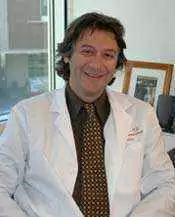
Alessio Fasano, M.D. (photo courtesy of University of Maryland)
Celiac disease is an autoimmune disease. The source of this being gluten, a protein found in wheat, barley, and rye, affecting about one percent of the population of 300 million Americans. It works by attacking the villi, the finger-like structures which line the small intestine, resulting in stomach problems and malabsorption of nutrients. Left untreated, the disease can cause severe health conditions and complications such as mental illness, osteoporosis, Anemia, miscarriage, and even cancer.
Alessio Fasano, professor of pediatrics, medicine and physiology as well as the director of the mucosal Biology Research Center and the Center for Celiac Research at the University of Maryland School of Medicine, has been researching celiac disease, paying particular attention to the way intestinal “permeability” influences the development of disease. In an article, published in Scientific American, called “Surprises from Celiac Disease,” Dr. Fasano poses the question of why some celiacs, who are born genetically predisposed to develop the disease, develop symptoms later than others. He suggests that reason for this is associated with the microbiome—the community of bacteria or microbes—living in the digestive tract.
According to Dr. Fasano, the digestive tract microbiome varies among individuals and even in the same individual over the course of a lifetime. What’s more, Dr. Fasano says they can also have an effect on the genes which are active in their host. Therefore, someone genetically predisposed to celiac disease may have been able to handle gluten for quite some time, but upon shifting of the microbiome, and a subsequent activation of the gluten intolerance gene, the symptoms of celiac disease will show themselves.
Not only do Dr. Fasano’s studies shed light into a question that has been perplexing researchers, but it also opens the door to a treatment for, or even prevention of, celiac disease—good bacteria for the digestive track, otherwise known as “probiotics.”
I spent years running in circles from doctor to doctor trying to find the cause of my painful symptoms, finally driving me to research my symptoms on my own. I’m grateful to have been properly diagnosed, but managing the gluten-free diet can be a challenge. The prospect of a treatment such as probiotics to offset genetic factors will appeal to many celiacs like myself. Although the treatment for celiac disease is simple, it calls for a lot of work and can be disheartening at times, requiring a total lifestyle change.
With Dr. Fasano’s celiac disease research, we can look forward to more research, more awareness, and perhaps another treatment option. Meanwhile, let’s keep doing our parts to raise awareness and funds for celiac disease research.

As always, Celiac.com welcomes your comments (see below).
Article Options
24 Responses to "Probiotics: A Future Answer to Celiac Disease?" 
|
said this on
16 Jun 2010 5:40:31 AM PDT I am 38 and was diagnosed with celiac two years ago after years of fighting vague symptoms that started right after college. What is interesting about the probiotic treatment theory to me is that a year before my diagnosis, I started probiotics on my own to treat severe heart burn. I have always marked that as the beginning of my healing because it was my first autonomous act of taking control of my own health rather than completely relying on doctors. But, I never connected it with my celiac when later diagnosed. Now I'm wondering if there is connection between alcohol consumption and the microbiome. As I mentioned, looking back, my symptoms started as my college days were winding down. I never touched a drop of alcohol in high school, but I made up for 'lost' time in college. Now I wonder if the binge drinking was not only immature, stupid and pointless, but also the initial gunshot to my system.
|
|
said this on
23 Jun 2010 8:23:35 PM PDT Thank you for not only the information but your question. It is an extremely good question and yet I am not sure of the answer. I have my suspicions based off of research I have on probiotics yet my reply would not be facts, which I feel you are due. I think if you called the team up in Canada at BioK Plus and asked them. They may be able to help get this answered. I'd love to know their reply, and any other answers you get elsewhere. Thanks Malie.
Best, Tina Turbin |
|
said this on
15 Feb 2011 5:42:30 PM PDT I am a 50 year old female and I am having problems digesting all starchy foods. and any thing with milk. I'm not sure if this is called celiac? But it affects my breathing and my bathroom habits also! I have been on a gluten free diet but I'm still having problems. not as bad but i still do. I have lost weight. that's a plus. I just need help knowing the difference?
|
|
said this on
16 Jun 2010 12:11:39 PM PDT Fantastic article!
|
|
said this on
16 Jun 2010 2:37:34 PM PDT Love reading articles about and by Dr. Fasano. His article about the microbiome and how it could trigger celiac disease makes me wonder if those same genes could be turned off if someone developed just the right probiotic cocktail. I'm sure he's working on it.... For now, I take multiple strains of probiotics because it gives me hope that I might be fixing something!
Thanks for posting! |
|
said this on
22 Jun 2010 1:55:48 PM PDT Hello Jennifer, Thank you very much for your comment and I'm glad you enjoyed the article. To your health! Tina
|
|
said this on
17 Jun 2010 6:19:57 PM PDT I was diagnosed late in life with celiac disease. I had no symptoms, but started having digestive problems, and an endoscopy showed celiac disease. The culprit for the digestive problems turned out to be a medication I was on. However, because of all the tests and medications, I developed a lot of diarrhea with a sense of urgency. I began taking Align, a probiotic, and it cleared up the problem. I still am asymptomatic for celiac disease without the aid of a gluten-free diet, and I still take the probiotic. So I'm hoping there is something to Dr. Fasano's research.
|
|
said this on
18 Jun 2010 11:47:30 AM PDT Oh ,one more thing fresh probiotic stuff like real foods is the best. But if you live or work in a remote area, or live deep in the city or suburb and not near a supermarket, then it might be best to get the probiotic pills.
|
|
said this on
23 Jun 2010 4:52:10 PM PDT Yes, Jami, fermented foods are incredible. Happy they have helped you so much.
Tina |
|
said this on
23 Jun 2010 4:56:59 PM PDT Yes, you are right. I also highly suggest Bio-K Plus ( in many stores) as an excellent pro-biotic unless one wants to try the organic fermented cabbage- which is loaded but can cause a bit of gas and some celiacs have trouble adapting. The Bio-K Plus site is: biokplus.com/en/ Best, Tina
|
|
said this on
19 Jun 2010 11:11:37 AM PDT My son was diagnosed at 15 months old. The field of probiotics is still very new. I know that some yogurts contain probiotic cultures. Anything out there that can help is always beneficial.
|
|
said this on
23 Jun 2010 4:57:58 PM PDT Yes Holly, you are so right. Sometimes the "sugars" in the diet exasperate the Candida/yeast growth in some individuals from what I have read and researched, but I am not an MD. You can do a bit of a search on this and see if that is an issue with your son too. Also, I assume he is doing well on dairy since he likes Dannon. Good for him! Many celiacs do not have the enzymes to digest it and have issues that arise, as a result.
Tina Turbin |
|
said this on
03 Aug 2010 4:33:14 PM PDT I would love to know which specific probiotics help!
|
|
said this on
05 Aug 2010 8:28:28 PM PDT Bio-K Plus is really a good one but to find the right one for you will require your own homework. Look for ones that can guarantee their potency when ingested not at time of manufacturing. Many of the strains "die" by the time they hit the shelves and worse arrive to our homes.
|
|
said this on
05 Aug 2010 7:44:20 AM PDT Kefir is a great probiotic and can be found in most supermarkets.
|
|
said this on
03 Sep 2010 12:24:28 PM PDT My mother and brother are confirmed celiacs and I have had significant food challenges; going gluten free was like a light switch going off for my health. Alternatively, I have been taking probiotics (which is high in bifidobacteria and acidolphilis etc) and enzyme. I have had no problems for over two years both digestive, joints and eyes stay white and nasal inflammation low (some leaky gut I think before this). It works for me but have not seen clinical trials as to whether or not cancer risks are lowered. Its your risk but for me the probiotics three to four times a day have done well for me.
|
|
said this on
27 Mar 2011 11:35:56 PM PDT Um, excuse me, but if the disease affects 300 million Americans and there are only about 290 million of us total, does that mean all Americans are affected by celiac disease? Just a question.
|
|
said this on
12 Dec 2012 12:25:45 PM PDT Um, "affecting about one percent of the population of 300 million Americans" equates to 3 million. Perhaps a second, slower reading will help.
|
|
said this on
25 Jul 2011 1:43:05 PM PDT Interesting research. Surprisingly enough, both of my children, who have been on probiotics since they were 6 months old each, have celiac. I have long been a proponent of probiotics (mainly because I despise - DESPISE - the stomach flu, and that is how we avoid getting it), so nothing would make me happier than to give my children a probiotic that could help their disease!
|
|
said this on
09 Nov 2011 9:09:17 PM PDT I can't figure out what is wrong with my daughter...diarrhea and a light rash to her neck and chest for weeks/months at a time since about 6 months old (when she started food). She has been to many MDs including 2 gastro docs and one allergist. I started her on probiotics which helped some but the allergist said she might be allergic to milk even though it didn't show it on her blood test. I cut milk out and now the only time she has diarrhea/rash is when I ether introduce milk or stop the probiotics...could it be both celiac and milk allergy? Since you are a mom of 2 children I thought you might know...or where I could go for info.
|
|
said this on
24 Aug 2011 1:25:44 PM PDT I was diagnosed a few months ago and am just now finding my way with diet, etc. My diagnosis explains a lot about different health issues I've experienced my whole life, particularly the past decade (I'm 49). I have found a product called Candex which blasts candida cells. It's been like a miracle for my celiac and my interstitial cystitis (bladder disease).
|
|
said this on
07 Oct 2011 8:34:42 PM PDT Thank you for the information. I have "new" gastro problems and was diagnosed with interstitial cystitis over five years ago. None of the prescribed meds have worked. Probiotics and herbal supplements have been the only remedies that have helped my symptoms. I will be sure to try Candex.
|
|
said this on
27 Nov 2011 8:20:08 PM PDT Great article! I recently found out my 8 year old has CD. All of the doctors in the past passed her off as a "colicy" Baby but in my heart I knew it was something else. Her symptoms ranged from fatigue, severe abdominal pain, vomiting, muscle spasms, headaches, nasal congestion and eczema. She has been gluten free for one month and the change in her is amazing. It makes my over joyed to see my baby enjoy eating and not worry about tummy aches. I am a chef and love to cook for her so the gluten free issue has not been an issue. As long as she sticks to what God makes, i.e., fresh fruits and veggies and grass fed meats, she does wonderfully. Today I purchased probiotics and am hearing wonderful things about them but am apprehensive to start her with concerns of diarrhea or extra need to use the bathroom at school. Thank you so much!
|
|
said this on
09 Dec 2011 10:26:05 AM PDT Interesting to hear other accounts of celiac disease, my daughter was also diagnosed with being "colicy" and stranger anxiety, on different formulas as an infant all of which seemed to not work any different than the next, but had screaming fits as an infant making her hoarse! She has always complained about tummy aches and I thought it was anxiety maybe or for attention. My brother was diagnosed a few years ago, my daughter's "tummy aches" gradually became worse hunched up in a ball tears streaming down her face, so we are still trying to do away with gluten completely and started a probiotic a couple months ago. Ii feel like there are less tummy aches than before but having trouble with what to pack for lunches, tried rice cake PBJ she's sick of those. Thanks for your story anyway, and it's good to hear you're not alone!
|

Author)