
Jump to content
  • Welcome to Celiac.com!

    You have found your celiac tribe! Join us and ask questions in our forum, share your story, and connect with others.


  • Celiac.com Sponsor (A1):
    Celiac.com Sponsor (A1-M):
  • Get Celiac.com Updates:
    Support Our Content
    eNewsletter
    Donate
  • Scott Adams
    Scott Adams

    Do Severe Symptoms at Celiac Diagnosis Predict Long-Term Health? (+Video)

    Reviewed and edited by a celiac disease expert.

    People diagnosed with celiac disease often fear that severe early symptoms signal poor long-term health. This article explains new findings on alarm symptoms at diagnosis and what they truly mean for recovery, quality of life, and future outcomes.

    Do Severe Symptoms at Celiac Diagnosis Predict Long-Term Health? (+Video) - Image: Celiac.com ++ Watch the Video ++
    Caption: Image: Celiac.com ++ Watch the Video ++

    Celiac.com 02/09/2026 - Celiac disease is an immune-driven condition in which eating gluten causes damage to the lining of the small intestine. This damage interferes with nutrient absorption and can lead to a wide range of symptoms affecting both the digestive system and the rest of the body. Some people develop clear digestive complaints, while others experience symptoms such as fatigue, anemia, or bone weakness. Because the disease can look very different from person to person, diagnosis is sometimes delayed.

    Doctors often pay special attention to so-called “alarm symptoms” when evaluating digestive conditions. These symptoms include unintentional weight loss, anemia, vomiting, bleeding from the digestive tract, and difficulty swallowing. In many gastrointestinal diseases, alarm symptoms can signal serious underlying problems. In people with untreated celiac disease, alarm symptoms are known to be linked to more severe intestinal damage at the time of diagnosis. What has been less clear is whether these symptoms predict worse health outcomes years later, after treatment begins.

    Purpose of the Study

    Celiac.com Sponsor (A12):
    This study set out to answer an important question for patients and clinicians: do alarm symptoms at the time of celiac disease diagnosis lead to poorer long-term outcomes? Researchers wanted to know whether people who were sicker at diagnosis continued to struggle more with symptoms, intestinal healing, quality of life, or other health problems after many years on a gluten-free diet.

    Understanding this relationship is especially important as medical practice moves toward less invasive diagnostic approaches. If alarm symptoms do not predict worse long-term outcomes, this could influence how aggressively patients are monitored after diagnosis.

    How the Research Was Conducted

    The study followed more than eight hundred adults with biopsy-confirmed celiac disease. All participants had been living with the diagnosis for many years and had followed a gluten-free diet for a long period of time. The average duration of treatment was close to ten years.

    Researchers gathered information from medical records, interviews, blood tests, and validated questionnaires. They divided participants into two groups based on whether alarm symptoms were present at the time of diagnosis. Alarm symptoms included anemia, weight loss, vomiting, bleeding from the digestive tract, and black stools. Most people with alarm symptoms had anemia, weight loss, or both.

    The study compared these two groups across many factors, including intestinal damage at diagnosis, healing of the intestine after treatment, ongoing symptoms, quality of life, diet adherence, and the presence of other medical conditions.

    Findings at the Time of Diagnosis

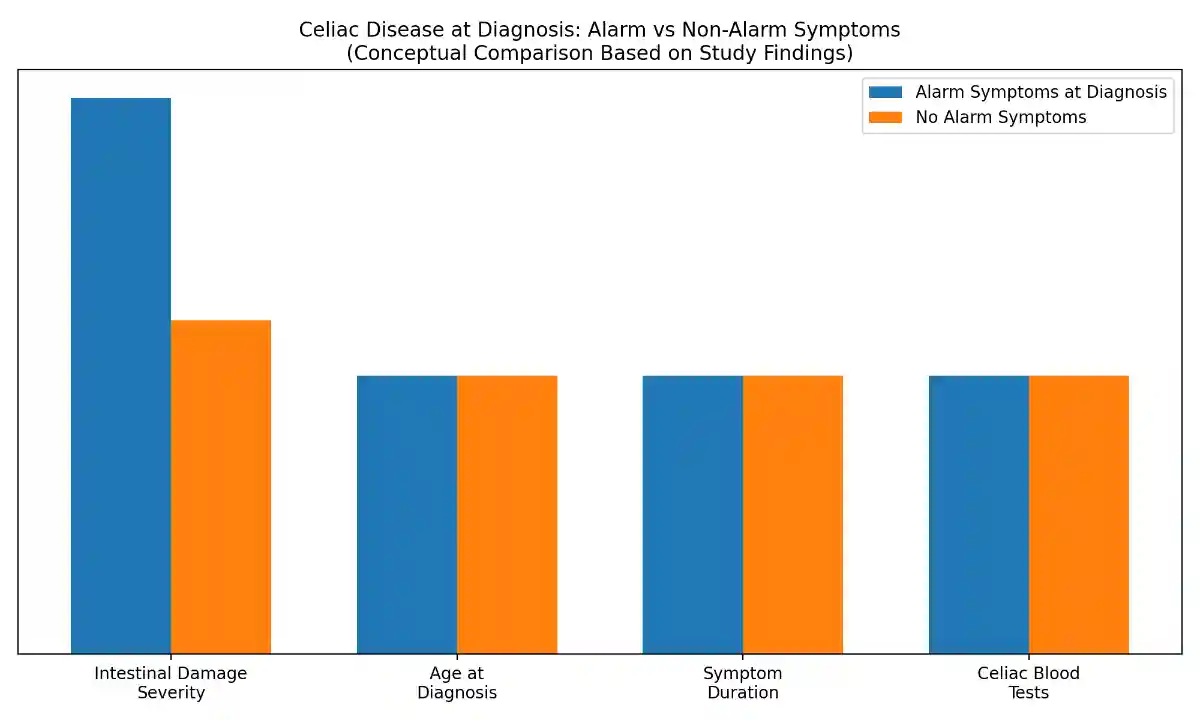
    Nearly half of the participants had at least one alarm symptom when they were diagnosed with celiac disease. Those with alarm symptoms were more likely to be women and tended to report more severe symptoms overall. They also showed more advanced damage to the intestinal lining, with greater loss of the finger-like structures that absorb nutrients.

    Despite this more severe initial presentation, people with alarm symptoms did not differ significantly from others in age or in how long they had experienced symptoms before diagnosis. Blood tests related to celiac disease were also similar between the two groups.
    celiac_alarm_vs_non_alarm_chart_conceptual.webp

    Long-Term Outcomes After Treatment

    After many years on a gluten-free diet, the differences between the two groups became much smaller. Both groups showed strong adherence to the diet, and blood tests used to monitor celiac disease activity were similar. Intestinal healing after one year of treatment was also comparable, with no major differences in long-term recovery of the intestinal lining.

    Quality of life scores and overall digestive symptom levels were nearly identical between those who had alarm symptoms at diagnosis and those who did not. Interestingly, people who had alarm symptoms initially were slightly less likely to report persistent symptoms years later.

    Bone Health and Other Conditions

    One notable difference did emerge during long-term follow-up. People who had alarm symptoms at diagnosis were more likely to have reduced bone density, including osteopenia or osteoporosis. This finding suggests that severe disease at diagnosis may have lasting effects on bone health, even when other outcomes improve.

    However, rates of fractures, cancer, and other autoimmune or chronic conditions were similar between the two groups. Overall, the presence of alarm symptoms did not translate into a higher burden of serious long-term complications.

    What These Results Mean

    The findings suggest that although alarm symptoms are linked to more severe disease at diagnosis, they do not necessarily predict worse long-term outcomes once treatment begins. With good adherence to a gluten-free diet, most people achieve similar levels of symptom control, intestinal healing, and quality of life, regardless of how severe their disease appeared at the start.

    The higher risk of bone density loss highlights the importance of monitoring bone health, especially in patients who had signs of malabsorption such as anemia or weight loss at diagnosis. Early nutritional deficiencies may have lasting effects that require ongoing attention.

    Why This Study Matters for People with Celiac Disease

    For individuals living with celiac disease, this study offers reassurance. A difficult or frightening diagnosis marked by weight loss or anemia does not mean that long-term health outcomes will be poor. With consistent treatment and follow-up care, many people recover well and enjoy a good quality of life.

    The study also reinforces the importance of early diagnosis and strict adherence to a gluten-free diet. While alarm symptoms should always be taken seriously, they do not automatically signal a worse future. Instead, they highlight the need for personalized care, including attention to bone health and nutritional recovery.

    Overall, this research supports a hopeful message: even when celiac disease begins with severe symptoms, effective treatment can level the playing field over time. For people with celiac disease and those at risk, the findings underscore the value of proper diagnosis, long-term dietary commitment, and individualized monitoring to achieve the best possible health outcomes.

    Read more at: journals.lww.com

    Watch the video version of this article:

    Watch the super short video version of this article:


    User Feedback

    Recommended Comments

    There are no comments to display.


    Create an account or sign in to comment

    You need to be a member in order to leave a comment

    Create an account

    Sign up for a new account in our community. It's easy!

    Register a new account

    Sign in

    Already have an account? Sign in here.

    Sign In Now

  • Get Celiac.com Updates:
    Support Celiac.com:
    Join eNewsletter
    Donate
  • About Me

    Scott Adams
    scott_adams_dotcomer.webp

    Scott Adams was diagnosed with celiac disease in 1994. Faced with a critical lack of resources, he dedicated himself to becoming an expert on the condition to achieve his own recovery.

    In 1995, he founded Celiac.com with a clear mission: to ensure no one would have to navigate celiac disease alone. The site has since grown into one of the oldest and most trusted patient-focused resources for celiac disease and the gluten-free lifestyle.

    His work to advance awareness and support includes:

    Today, Celiac.com remains his primary focus. To ensure unbiased information, the site does not sell products and is 100% advertiser supported.


  • Celiac.com Sponsor (A17):
    Celiac.com Sponsor (A17):


    Celiac.com Sponsors (A17-M):


  • Related Articles

    Scott Adams
    What Are the Symptoms of Celiac Disease?
    Celiac.com 09/19/2025 – Celiac disease is a chronic autoimmune condition triggered by eating gluten. It can cause a wide range of symptoms, from digestive problems to skin, bone, and neurological issues. Some people experience many symptoms on a daily basis, while others may have only a few or none at all. Because symptoms vary so widely, celiac disease can be difficult to recognize and diagnose.
    7 Major Categories of Celiac Symptoms
    Digestive symptoms: abdominal pain, bloating, gas, diarrhea, constipation, nausea, vomiting, steatorrhea (fatty stools). Non-digestive symptoms: fatigue, weakness, anemia, weight loss, malnutrition, delayed growth, irritability, depression, anxiety, brain fog. Skin symptoms: itchy rash, blistering, dermatitis herpetiformis, e...


    Jefferson Adams
    Full Gut Recovery from Celiac Disease Can Take Up to Two Years
    Celiac.com 03/14/2017 - Recent studies of adult celiacs have suggested that complete, not just partial, mucosal recovery and healing is possible, but, in many cases, may take longer than is currently understood.
    Recently Dr. Hugh James Freeman of the Department of Medicine, Gastroenterology, University of British Columbia, Vancouver, BC, Canada, conducted a study to assess healing time in celiac patients. In this study, 182 patients (60 males, 122 females) referred for evaluation of symptoms, including diarrhea and weight loss, were selected only if initial biopsies showed characteristic inflammatory changes with severe architectural disturbance.
    All patients were treated with a strict gluten-free diet, and diet compliance was regularly monitored. Up to 90% or more of patients showed...


    Laura Yick
    Recovery and the Process of Healing
    Celiac.com 03/09/2023 - After nearly a year on a gluten-free diet, I now look back at my recovery to evaluate its success—the severe joint pain, muscle weakness, bone pain, fatigue, abdominal bloating, steatorrhea, and weight loss plagued me until my treatment commenced in earnest. Much of the extra-intestinal symptoms resolved within the first few months. However, the intestinal and stomach symptoms have taken much longer, and my weight loss recovery is ongoing. The road to recovery has been long and arduous. Many of us experience an array of residual and persistent symptoms even with the complete removal of gluten from our diets.
    Intestinal Absorption
    Traditionally, response to a gluten-free diet has been assessed by blood antibody tests and biopsies. It has long been k...


    Scott Adams
    Why Some Children with Celiac Disease Have More Severe Intestinal Damage (+Video)
    Celiac.com 02/03/2026 - Celiac disease is an immune-based condition in which the body reacts abnormally to gluten, a protein found in wheat, barley, and rye. When a child with celiac disease eats gluten, the immune system attacks the lining of the small intestine. Over time, this reaction damages the intestinal surface, making it difficult to absorb nutrients properly. While celiac disease is best known for its digestive symptoms, it is also closely linked to the immune system and can overlap with other autoimmune conditions.
    Autoimmune diseases often cluster together, meaning that a person with one autoimmune condition is more likely to develop others. In children with celiac disease, doctors have long observed higher rates of immune conditions affecting the thyroid gland and the...


  • Recent Activity

    1. - Haugeabs replied to Jane02's topic in Gluten-Free Foods, Products, Shopping & Medications
      23

      Desperately need a vitamin D supplement. I've reacted to most brands I've tried.

    2. - trents replied to xxnonamexx's topic in Gluten-Free Foods, Products, Shopping & Medications
      7

      FDA looking for input on Celiac Gluten sensitivity labeling PLEASE READ and submit your suggestions

    3. - Wheatwacked replied to Heatherisle's topic in Celiac Disease Pre-Diagnosis, Testing & Symptoms
      34

      Blood results

    4. - Known1 replied to xxnonamexx's topic in Gluten-Free Foods, Products, Shopping & Medications
      7

      FDA looking for input on Celiac Gluten sensitivity labeling PLEASE READ and submit your suggestions

  • Celiac.com Sponsor (A19):
  • Member Statistics

    • Total Members
      133,413
    • Most Online (within 30 mins)
      7,748

    EBeloved
    Newest Member
    EBeloved
    Joined
  • Celiac.com Sponsor (A20):
  • Celiac.com Sponsor (A22):
  • Forum Statistics

    • Total Topics
      121.6k
    • Total Posts
      1m
  • Celiac.com Sponsor (A21):
  • Popular Now

    • Known1
      6
    • catnapt
    • Jane02
    • Olenaideole
  • Popular Articles

    • Scott Adams
    • Scott Adams
    • Scott Adams
    • Scott Adams
    • Scott Adams
  • Upcoming Events

×
×
  • Create New...

Important Information

NOTICE: This site places This site places cookies on your device (Cookie settings). on your device. Continued use is acceptance of our Terms of Use, and Privacy Policy.