


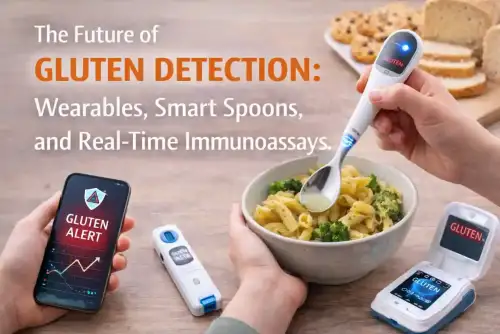
Celiac.com 01/30/2026 - For people with celiac disease or gluten sensitivity, avoiding gluten is not optional. Even very small amounts can cause symptoms, intestinal injury, or long-term health risks. Despite careful label reading and strict dietary habits, accidental gluten exposure remains common. Cross-contact in restaurants, shared kitchens, and food manufacturing environments continues to be a major challenge.
Because of these ongoing risks, researchers and technology developers are exploring new ways to detect gluten closer to the moment it is consumed. Some of these ideas are already appearing in early commercial products, while others remain experimental or conceptual. Together, they point toward a future in which gluten detection may become more immediate, personalized, and proactive.
The Limits of Current Gluten Safety Systems
Celiac.com Sponsor (A12):
Today, gluten safety depends largely on pre-market testing and labeling. Food manufacturers test products before packaging, and regulatory thresholds define when a product may be labeled as gluten-free. These systems are essential, but they have limits. They cannot account for what happens after a product leaves the factory.
In everyday life, gluten exposure often comes from cross-contact rather than mislabeled foods. A clean ingredient list does not guarantee a safe meal when shared preparation surfaces, utensils, or storage are involved. Current systems place most of the burden on individuals to assess risk in real time, often with incomplete information.
This gap has inspired interest in technologies that could help detect gluten during or immediately before consumption, rather than relying solely on labels and trust.
Portable Food Testing Devices
One area of active development involves small, portable devices that test food for gluten at the point of use. These systems typically rely on immune-based detection methods similar to those used in laboratories, but adapted for consumer use. In practice, a small sample of food is tested, and the device indicates whether gluten is detected above a certain threshold.
While some versions of these devices already exist, they have limitations. Testing requires a representative food sample, which can be difficult with mixed dishes, sauces, or unevenly distributed ingredients. Results may vary depending on how the sample is prepared and how sensitive the detection method is.
Even with these limitations, portable testing tools represent a meaningful step toward giving individuals more control when eating outside the home.
Smart Utensils as a Conceptual Approach
Another idea attracting attention is the concept of smart utensils, such as spoons or forks equipped with sensors. In theory, these utensils would analyze food directly as it is eaten and provide immediate feedback if gluten is detected.
At present, this idea remains largely hypothetical. While prototypes and demonstrations have been discussed, reliably detecting gluten in complex foods in real time presents significant technical challenges. Food composition, moisture, temperature, and cross-contact residues all complicate accurate measurement.
If these challenges can be overcome, smart utensils could reduce the need for separate testing steps and make gluten detection more intuitive. For now, they remain a promising but unproven concept.
Wearable Devices and Biological Monitoring
Beyond detecting gluten in food, some researchers are exploring whether the body itself could serve as an indirect indicator of gluten exposure. This concept draws inspiration from wearable devices used in other medical fields, such as continuous glucose monitors.
In theory, wearable sensors could track biological signals associated with immune activation or inflammation after gluten ingestion. These signals might be measured in sweat, saliva, or interstitial fluid. Rather than confirming gluten in a specific meal, such systems would suggest that exposure has occurred.
At present, this approach is experimental, and there are urine and stool tests available that can detect gluten very soon after you eat it. The immune response to gluten varies widely between individuals and may be delayed or subtle. Translating these signals into reliable, real-time alerts remains a significant scientific hurdle.
Saliva-Based and Immune Response Prediction Tools
Another hypothetical direction involves monitoring immune markers that rise after gluten exposure. Some research has explored whether antibodies or other immune signals could be detected in saliva or other easily collected samples.
In the future, such tools might help individuals understand whether ongoing symptoms are related to recent gluten exposure or to other dietary factors. However, immune responses do not always correlate neatly with symptoms, and repeated testing could introduce confusion rather than clarity.
For now, immune-based prediction systems remain a research concept rather than a practical consumer solution.
Smart Kitchens and Environmental Monitoring
Gluten detection technology may not be limited to personal devices. Another theoretical application is the development of smart kitchen environments. Sensors embedded in preparation surfaces, appliances, or workflows could alert users or staff when cross-contact is likely.
In restaurant or institutional settings, such systems could help standardize gluten-free preparation practices and reduce reliance on memory and training alone. While this idea aligns with broader trends in food safety automation, it has not yet been widely implemented for gluten control.
If developed responsibly, environmental monitoring could shift some of the burden of gluten safety away from individuals and toward shared spaces.
The Role of Data and Learning Systems
Many proposed gluten detection technologies involve mobile applications and data tracking. Over time, these systems could identify patterns related to specific foods, locations, or preparation methods. This information might help users make better-informed decisions and reduce anxiety.
However, data-driven systems raise important questions. Accuracy, interpretation, and privacy are critical concerns. False alerts could unnecessarily restrict diets, while missed detections could lead to harm. Any system that collects biological or behavioral data must also protect user privacy.
What This Means for People With Celiac Disease
For people with celiac disease, the promise of future gluten detection technologies is significant. Real-time or near-real-time feedback could reduce accidental exposure, protect intestinal health, and improve confidence when eating outside the home.
At the same time, it is important to recognize that no technology can eliminate risk entirely. These tools, if they mature, would serve as aids rather than replacements for medical guidance and careful dietary practices.
Clear communication about what is proven, what is experimental, and what remains hypothetical will be essential to ensure that emerging technologies empower rather than mislead.
Implications for Gluten Sensitivity
People who experience symptoms related to gluten without a formal diagnosis often face even greater uncertainty. Hypothetical detection and monitoring tools could help clarify whether symptoms align with gluten exposure or with other dietary triggers.
However, variability in individual responses means that personalized interpretation would be necessary. Technology alone cannot define tolerance levels or diagnose conditions.
Conclusion: Cautious Optimism for the Future
The future of gluten detection is being shaped by a mix of existing tools, emerging research, and ambitious ideas. Some technologies are already available in limited forms, while others remain hypothetical or experimental.
For people with celiac disease or gluten sensitivity, these innovations offer cautious optimism. If developed carefully, validated rigorously, and communicated honestly, future gluten detection tools could reduce uncertainty and improve quality of life.
Until then, they should be viewed as evolving concepts rather than guaranteed solutions, supporting—not replacing—the foundational principles of gluten-free safety and medical care.










Recommended Comments
Create an account or sign in to comment
You need to be a member in order to leave a comment
Create an account
Sign up for a new account in our community. It's easy!
Register a new accountSign in
Already have an account? Sign in here.
Sign In Now