


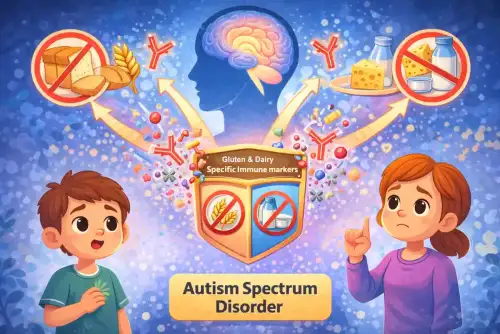
Celiac.com 02/25/2026 - Families often ask whether removing gluten and dairy can improve symptoms in children with autism spectrum disorder, especially when digestive symptoms or suspected food reactions are involved. Research on this topic has been mixed, partly because diet studies are difficult to design and people may change many things at once (not just one ingredient). The researchers aimed to add another layer of evidence by asking:
- Are some dietary factors linked to autism spectrum disorder risk when analyzed through genetics?
- In clinical practice, does a gluten-free and casein-free diet change autism-related symptom scores or immune reactions to milk and wheat?
- Could immune system markers help explain any observed links?
How the genetics-based analysis worked (explained simply)
The genetics portion used a method called Mendelian randomization. In plain language, this approach looks at inherited genetic variants that are associated with tendencies toward higher intake of certain foods. Because genes are assigned at conception, this method is sometimes used to reduce the impact of lifestyle confounding (for example, differences in income, health care access, or overall diet quality).
Celiac.com Sponsor (A12):
The authors tested many dietary factors and then highlighted a few foods that appeared to show genetic associations with autism spectrum disorder risk. They also emphasized an important limitation: these genetic estimates reflect long-term, lifelong tendencies tied to genetic predisposition, not the short-term effect of eating a food for a few days or weeks. The statistical uncertainty was also large for the strongest signals, meaning the true size of any effect could be much smaller (or different) than the point estimate suggests.
Main genetics findings
Among the many foods examined, the analysis suggested that a genetic tendency toward higher intake of wholemeal pasta and cheese spread was associated with a higher likelihood of autism spectrum disorder. In contrast, a genetic tendency toward higher banana intake was associated with a lower likelihood of autism spectrum disorder.
The study did not find clear evidence that blood ketone-related measures or food allergy status (in general) had a statistically strong genetic relationship with autism spectrum disorder in their primary tests, although the direction of some estimates suggested possible protective patterns that did not reach strong statistical certainty.
What the researchers found when they looked at real children in clinic records
The clinical portion was a retrospective study, meaning the researchers looked back at existing records rather than assigning children randomly to diets. They included 78 children aged 2 to 7 years who had autism spectrum disorder diagnoses. Families chose whether to follow a gluten-free and casein-free diet or continue a typical diet, which is important because family choice can introduce differences between groups that are hard to fully control.
The researchers compared changes over time in two types of outcomes:
- Autism symptom scoring using standard clinical rating tools
- Food-related immune response markers, specifically milk- and wheat-targeted immunoglobulin G levels
Symptom scores: no clear “winner,” but a trend
When the researchers adjusted for baseline differences and analyzed follow-up scores, they did not find a statistically strong difference between the diet groups for autism symptom scores. In other words, the data did not allow them to confidently say that the gluten-free and casein-free diet clearly improved core symptoms more than the usual diet.
However, the gluten-free and casein-free diet group showed a larger average improvement in symptom scores compared with the usual diet group. The authors interpreted this as a potentially meaningful trend that might become clearer in larger, better-controlled studies.
Immune markers: a stronger signal than symptom scores
The clearest clinical finding was that the gluten-free and casein-free diet group showed a significant reduction in milk-targeted and wheat-targeted immunoglobulin G levels over time compared with the usual diet group. In simple terms, the diet was associated with a measurable shift in these food-specific immune response markers.
This matters because it suggests that for at least some children, removing gluten and dairy proteins may change immune reactivity to those foods. Whether that immune change translates into consistent, clinically meaningful changes in autism-related behavior remains uncertain based on this dataset.
Possible explanation: immune pathways as a bridge between diet and symptoms
The researchers also explored whether certain immune features could help explain the association between cheese spread intake and autism spectrum disorder in the genetics-based analysis. Their mediation work pointed to immune-related markers that might partially connect the dietary factor signal to autism spectrum disorder risk. This does not prove a mechanism, but it supports the idea that immune activity could be part of the larger story for some individuals.
The authors discussed broader theories involving digestion, intestinal barrier function, food-derived peptides, immune activation, and gut microbiota changes. They also noted that dietary strategies are best viewed as supportive measures, not as stand-alone treatment for autism spectrum disorder.
Important limits to keep in mind
- Retrospective design: Families were not randomly assigned to diets, so motivation, resources, and other health changes could influence results.
- Small sample size: The clinical study was relatively small, making it harder to detect moderate effects on symptom scores.
- Genetics signals are not the same as short-term diet effects: A genetic tendency linked to a food pattern is not proof that eating that food directly causes autism spectrum disorder.
- Food-specific immunoglobulin G is complex: Changes in food-targeted immunoglobulin G levels may reflect exposure and immune response patterns, but do not automatically diagnose a harmful reaction in every person.
Why this could matter to people with celiac disease
Although this study focused on autism spectrum disorder, it touches on themes that are highly relevant to celiac disease: gluten exposure, immune responses to food proteins, and the possibility that dietary removal changes measurable immune markers and symptoms in some people. For individuals with celiac disease, gluten is not a lifestyle choice but a medical trigger that can cause intestinal injury and wide-ranging symptoms beyond digestion.
The main takeaway for the celiac community is not that gluten causes autism spectrum disorder, but that immune responses to dietary proteins can be measurable and meaningful in certain settings. This supports a broader, familiar concept in celiac care: dietary proteins can interact with the immune system in ways that may affect the whole body, not just the gut. It also reinforces a practical point: if someone suspects celiac disease, they should pursue proper medical testing and guidance before making long-term dietary changes, because diagnosis depends on correct timing and evaluation.
In short, this study adds to ongoing discussion about how diet and immune activity may intersect in complex conditions. For people with celiac disease, it is another reminder that food-triggered immune responses are real, measurable, and worth taking seriously, even when symptoms vary and are not limited to digestion.
Read more at: frontiersin.org














Recommended Comments
There are no comments to display.
Create an account or sign in to comment
You need to be a member in order to leave a comment
Create an account
Sign up for a new account in our community. It's easy!
Register a new accountSign in
Already have an account? Sign in here.
Sign In Now